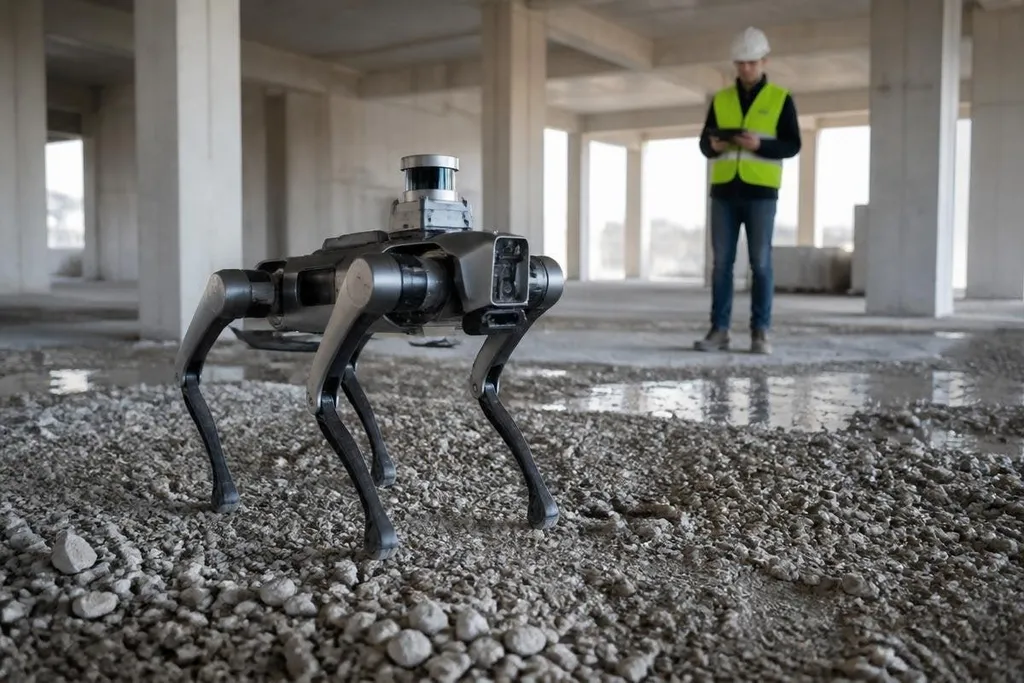
A robot dog can already walk, turn, and carry sensors. AI changes the software that helps it read a space, choose a route, and recover when the ground does not match its map. For a buyer, the useful question is where that software works and where it still needs a human.
- AI turns camera and LiDAR data into a map the robot can use.
- New control software can adjust foot placement as the robot moves.
- Battery life, payload, weather sealing, and safety still set the hard limits.
From fixed commands to local decisions
Older control systems often depend on set routes, fixed motions, or remote commands. An AI system can take data from cameras, LiDAR, joint sensors, and an inertial measurement unit, then use that data to choose its next movement.
LiDAR measures distance with light pulses. The robot uses those readings to spot walls, steps, gaps, and objects. Cameras add color and shape, while joint sensors report the position and force at each leg.
That does not mean the robot understands a room like a person. It means the software can match new sensor data with stored patterns and rules. If a box blocks a route, the robot may stop, turn, or choose another path, depending on how its control system was built.
The change matters most in places that are hard to model in advance. A plant floor may have temporary barriers, uneven surfaces, or equipment in a different position from the day before.
Fixed routes break when the layout changes. A system that checks the space as it moves has more ways to respond.
Better movement, with limits
AI can also help with locomotion. The software may adjust step length, leg height, body position, or speed as the robot crosses a surface. That can help it keep its balance when one foot meets a slope or loose material.
The robot still needs motors with enough torque, a frame that can take the load, and sensors that work in the conditions around it. Software cannot give a small battery more energy or make a light leg lift a heavy object.
This is where many product claims need careful reading. Walking over a short patch of rough ground in a controlled test shows one ability. It has not proved that the same behavior will work for hours, in rain, around people, while carrying a payload.
Language makes robots easier to use
Some AI systems let people give commands in ordinary language. A worker could ask the robot to inspect a marked area, return to its charging point, or report an object beside a door. The software still has to convert that request into safe actions.
That conversion is the hard part. “Inspect the pump” needs a known location, a camera view, a safe distance, and a rule for what counts as a fault. If any part is unclear, the robot should ask for help or stop.
A useful demo record names the command, route, sensor view, stop event, and final report. For a robotics manager comparing machines, Robot24.com deployment reporting can add the company, site, date, and task behind a claim. That record helps you tell a live test from a polished walk before the next section looks at what AI still can't fix.
What AI cannot fix
AI needs data. Poor lighting can weaken camera results. Dust, rain, glass, and reflective metal can affect sensors. A map can also become wrong when people move equipment or close a passage.
Safety adds another limit. Near people, the robot dog needs a clear stop system, known operating rules, and a way for a person to take control. A smart planner does not remove the need for a safe work area.
The cost question also goes beyond the robot's purchase price. You may need charging equipment, network access, software updates, staff training, spare parts, and a person who checks the data. A robot that saves inspection time only helps if those extra tasks fit the site.
A practical buying check
Use this list before you compare AI features:
- Name the task: Write down the job, location, shift length, and payload.
- Watch the full run: Ask to see startup, travel, task work, failure handling, and return.
- Check sensor limits: Ask how the system behaves in darkness, rain, dust, and reflective areas.
- Test the stop path: Find the physical stop, remote stop, and manual recovery method.
- Price the support: Include software fees, training, batteries, repairs, and network needs.
- Ask what is unproven: Separate a live customer result from a lab or video demo.
I'd skip any robot dog whose AI pitch comes without a clear task, test condition, and recovery plan.
AI will make robot dogs better at handling changing ground and sensor data. The next useful proof is not a harder stunt. It is a repeatable job that runs for a full shift, records its mistakes, and tells a person when it cannot continue.